
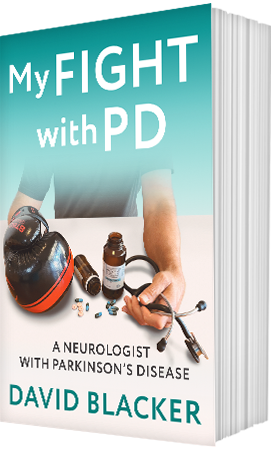
My FIGHT with PD
by Dr David Blacker AM
An Extract from: My FIGHT with PD: A Neurologist with Parkinson’s Disease
Introduction
In late 2018, I revealed to family, friends and colleagues that I have PD. This marked a change in the direction of my life and career. It has led me down a path I had never expected to pursue, but in many ways I was well prepared for. Curiously, my own experience with PD may have made my life more meaningful and fulfilling. As a neurologist and medical researcher who has PD, I have a unique opportunity to incorporate what I have experienced as a person with PD into research and treatment for others. This book describes my life story and the impact PD has had on me. Where possible, I try to provide some information about PD, as well as my perceptions and feelings. I hope this might benefit others with PD and their families.
The acronym FIGHT stands for Feasibility of Instituting Graduated High-intensity Training. This was a clinical feasibility trial of exercise using non-contact boxing that I developed with former boxing champion Rai Fazio and some prominent sports scientists. The experience of designing, undertaking, then having the trial published, has been one of the highlights of my career and occurred while I was coming to terms with retiring early from clinical practice due to the impact of PD and a series of other health issues. The power of exercise, positive attitude and the amazing support from my wife have helped me to continue to live well, and convinced me that these interventions when applied promptly and expertly, can alter the course of PD. It has also given me a second career advocating and fighting for the benefit of people with PD.
Overview
This book has three sections. The first, ‘Before the fight,’ explains my personal and professional background and describes the emergence of PD symptoms, their impact on me, the diagnosis and early years of treatment. The second, ‘FIGHTing PD’ outlines how I have tackled my own PD, particularly through the use of exercise. I describe how I joined forces with Rai Fazio, former boxing champion, and a team of exercise scientists to create an exercise program based around non-contact boxing, which we named FIGHT-PD. The third, ‘The FIGHT is not over,’ describes my ongoing efforts to keep PD at bay from 2022 to 2024, in the face of a series of other illnesses. These included a bout of COVID-19, three eye operations, depression and prostate cancer. It was also the time during which I retired from clinical work. The section concludes with my rededication to exercise, adjustment of medications and reorganising of priorities, all of which helped to pull me back from acceleration of PD symptoms. I then outline three projects commenced during 2024, which had immediate impact for PwP: a specific clinic for newly diagnosed PwP, a program introducing yoga to PwP designed and run with my wife Kirsten, and my ongoing work with Rai bringing what we learned in FIGHT-PD to as many PwP as we can.
I conclude by describing the issue of pesticides and the possible link to PD which captured a lot of my attention from the second half of 2024 onwards. However, I suspect my greatest opportunity to make a difference will continue to be using my rare position as a PwP and neurologist to help both groups understand each other more closely and enrich the clinical relationship.
Symptoms at work
While the impact on my golf was annoying, when it started to influence my work, I began to realise that I would have to do something about it soon. My previously energetic bounding gait which would include zooming up several flights of stairs as the team trailed behind, was becoming an ungainly trudge across the hospital. When colleagues commented, I’d brush it off, saying I was a bit sore from running too much. I developed a habit of holding my small exam bag (proudly brought back from the Mayo Clinic – a symbol amongst neurologists of doing time there) in the crook of my bent and slow moving right elbow. My handwriting, never good to begin with, was becoming a laborious scrawl. Initially, I minimised the issue by laughing it off as ‘typical doctors handwriting,’ and by making a conscious effort to be more concise. I would try to complete as many forms as I could before the patients came into my office. Looking back through my outpatient notes, I could clearly see the deterioration. At times, I started using my left hand to move the right hand with the pen. What became more disturbing was my observation that many of my PD patients were moving more freely than I was.
Reaction to the diagnosis
The weeks following the formal diagnosis and commencement of medication were difficult. Even though I knew it was coming, to hear it being confirmed still had a powerful effect. On the positive side, it confirmed that I was not imagining the symptoms, and it wasn’t something else – a few irrational thoughts about alternative, more sinister pathologies had been swirling around in the back of my mind. There was also some validation of my own diagnosis; not that there was much doubt when the symptoms and signs were assessed objectively, but I had started to doubt myself. What I found particularly difficult was a shift in my thinking about the future. My previous mental picture was of looking forward to a very active retirement, perhaps still doing some private work and research, but also enjoying a lot of travel with Kirsten. In addition, I’d hoped to finally have some time to put in extra practice and improve my golf game, and even get good enough to play in some amateur tournaments again and perhaps in senior pennants. I suddenly felt that all of this wasn’t going to happen, and that because of the nature of PD, I would inevitably progress and get functionally worse because that is what is supposed to happen in PD. This feeling of the future I had planned being taken away, was probably the worst part of the early post diagnosis time.
Rai Fazio – a boxer joins the fight
Shortly before the COVID calamity began to impact everything in March, an alignment of circumstances and opportunities (some people call it fate), occurred that would shape my future, redirect my career and significantly improve my health.
The story of how Rai and I were drawn together is remarkable and full of co-incidences. Some have described us as ‘the professor and the pugilist.’ Rai probably never imagined that he would be reading scientific articles and contributing to academic meetings and papers; and I never imagined I would be looking at video clips of Mike Tyson.
FIGHT-PD– the middle rounds
During this middle block, we were able to crank up the music accompanying the workouts. In the first block, we had to keep quiet for many of the workouts because student exams were underway in a nearby part of the gymnasium complex. With this restriction gone, Mitchell supplied a ‘boombox’ and Rai the soundtrack, which was heavy on classic 1980s hard rock, especially ACDC. This was the music of Rai’s and my teenage years, and most of the Fighters loved it too. One of the highlights towards the end of the program came from one of our Fighters, a retiree who had previously worked in radio, and had been a DJ. He is a Scotsman, so one day he wore a kilt for the workout. The ACDC classic, ‘It’s a long way to the top,’ contains a bagpipe section, during which time he really rocked the kilt. The addition of music to the middle block really seemed to make the exertion easier. I vividly recall one Friday morning when the group was just buzzing along at a very high rate of exercise in time with the music. I was also training with them, with dopamine, caffeine and exercise levels all optimised; it was the best I had felt in years; almost elated. Most participants reported similar windows of exercise-induced wellbeing, even euphoria.
The final bell and beyond
In early September we finished FIGHT-PD. The final workout was quite emotional. There were speeches and thanks. There were some tears, but overall, there was a great sense of accomplishment and a definite sense that this was not the end. I told the Fighters that I very much hoped that the fitness, strength and confidence they had developed would continue for the remainder of their lives. The whole study was exhilarating, and Rai, I and the other team members were proud of what we had achieved. We only had to look at how well the Fighters were moving, and how trim they looked, to see how far they had come.
100 days of cancer
I felt a great sense of frustration and exhaustion, as yet another health struggle now loomed. Looking back over the previous year or so, I’d now had COVID in May 2022, two cataract surgeries in August 2022, a depressive episode in September/October 2022 and deterioration of PD symptoms. By early 2023 it felt like I was starting to get back on top of things; then the retinal detachment in May 2023 knocked me down again. My vision was continuing to improve, but it was still obscured and I was resigned to the fact there were likely to be ongoing problems with my eyesight. And NOW CANCER!! I wondered if I had the energy left to go through another medical battle.
I looked out of the hotel room window at the Melbourne skyline. Unlike most hotel room windows, this one could be opened fully. For a very brief moment I looked down, wondering if I was high enough up to ensure certain death if I jumped.
Taking stock and seeing the silver lining
People unfamiliar with PD, and many PwP, may find it strange that I believe my life to be better for the experience of having PD. No doubt, my view might change in the future, but at this stage I feel as if I’ve been granted several surprising gifts: I have been forced to slow down and become more appreciative, and grateful of everything; I have come to understand the value of mindfulness and it has strengthened my already fantastic relationship with my wife. (Kirsten has been amazing with the ‘in sickness’ part of the marriage vows.) I have done things (like boxing training) and met people (like Rai) I never would have otherwise. Despite the physical limitations, I find myself to be mentally freer than ever before. I read much more widely now, including fiction. As a neurologist, it has given me an incredible opportunity to assist PwP and to help my colleagues understand more deeply the experience of living with PD.
To purchase the book, click on your chosen link: